Everyone screens callers the same way
Post the job. Wait for the applications to pile up. Skim resumes for a few seconds each, whatever gets you through the stack. Pull the ones that look right onto a call, and go with a gut read from there.
That's not a hiring process. It's a filter with no signal in it.
The actual story is quieter than the surface one. Most operations hiring outbound callers, us included until recently, aren't running a screening process at all. They're running a fast skim followed by an expensive bet.
Six seconds is the whole signal
The Ladders ran an eye-tracking study on resume review and found recruiters spend an average of six seconds looking at a resume, seven and a half by their more recent follow-up. Not six minutes. Six seconds.
That's the entire signal most callers get evaluated on before someone decides whether to burn thirty minutes of a hiring manager's time on a call.
For a role like outbound calling, that's the wrong six seconds to spend. Nothing on a resume tells you whether someone can handle an objection without freezing, hold to a script under pressure, or manage their own pipeline without someone checking in every hour. That signal doesn't live in a resume. It lives in how someone actually answers a real scenario, in detail, under the same kind of pressure the job puts on them daily.
Skimming for six seconds is optimizing for speed. A real signal only shows up when someone reads the whole answer.
Nobody has time to read the whole answer for every applicant that comes through. So most teams don't. They skim, they guess, and they pay the skim-and-gut-call tax later, in bad hires, wasted onboarding, and calls that don't convert.
This is a reading problem, not a hiring problem
The mistake isn't the resume. It's assuming a human has to be the one doing the reading.
We didn't need a better interview process. We needed something that could read every full scenario answer at the same depth a great hiring manager would bring to a single one, and do it at a speed no human has.
The signals a resume never shows you
We built our screening process around the things a resume can't tell you, and a six-second skim definitely can't.
Whether someone can actually operate in the systems the job runs on. Not a resume line: a direct answer to a direct scenario.
Whether they have a real answer when a prospect pushes back. The kind of thing that separates someone who can handle an objection from someone who freezes. It shows up immediately in how they work through a real scenario, not in whether they list "strong communicator" on a resume.
Whether they can hold a script under pressure without going off the rails. The difference between a caller who protects the brand on every call and one who improvises their way into a compliance problem.
Whether they can run their own pipeline without a manager checking in every hour. Something everyone claims on a resume and almost no one can actually show.
None of that shows up in six seconds of skimming. It shows up when someone has to answer a real scenario in depth, and something actually reads it.
How it actually works
Every applicant answers a short set of real scenarios built for the role, plus a voice sample, so we hear how someone actually sounds on a call, not just how they write. Whatever comes in gets scored automatically against a rubric built for the role, and comes back in seconds, not days, with a clear score, a hire signal, and a short summary a hiring manager or recruiter can act on immediately.
That's the actual unlock. Not a faster form. By the fiftieth application, nobody is really reading anymore, they're pattern-matching to get through the stack. That's decision fatigue, not laziness, and no amount of trying harder fixes it. A hiring manager or recruiter who used to spend hours working through a pile of applications now spends minutes deciding, because the reading and the first-pass judgment already happened before the file lands on their desk.
Whoever runs screening works off a ranked dashboard, sorted by score, every candidate's answers and the reasoning behind their score one click away. Hiring managers get a separate, read-only view of only the candidates assigned to them, with their own decisions and notes flowing straight back to the dashboard. No follow-up message needed to find out where a candidate stands.
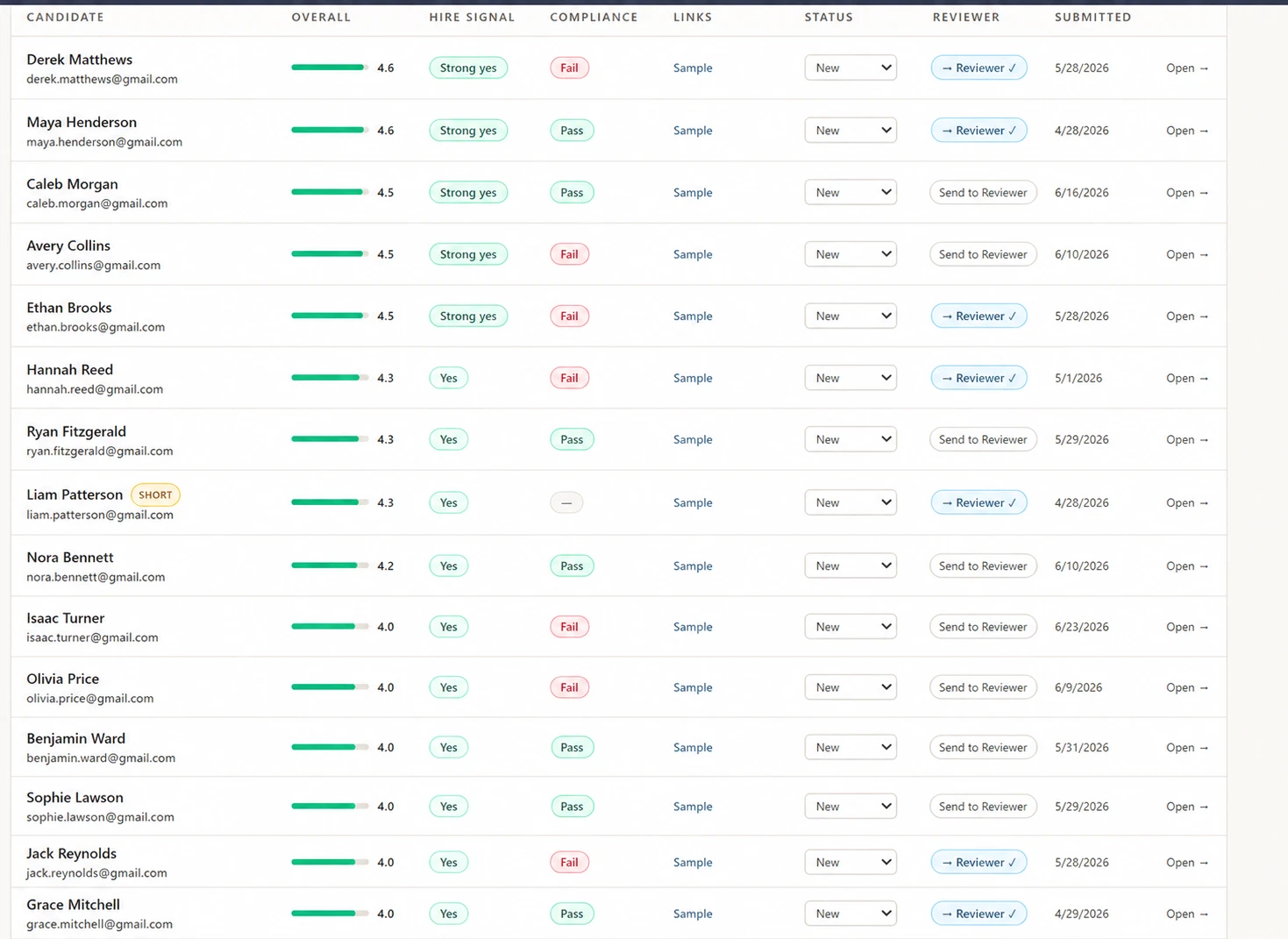
The skim gave you a guess. The score gives you a reason.
Before this existed, our hiring manager Neil was getting a shortlist from the recruiter and scheduling calls himself to figure out if anyone on it could actually handle the job. Thirty-minute screens multiplied across however many looked okay on paper. The ones who made it through still sometimes folded on the first real objection once they were on the phones. That cost showed up later: in ramp time, in calls that didn't convert, in starting the search over.
Now Neil opens his list and spends his time deciding instead of discovering. He makes his decision, adds a note, and it flows straight back to the recruiter. No back-and-forth. No scheduling a thirty-minute screen to learn what a scenario answer already told him.
So far, 86 applicants have run through the system. Nine scored high enough to land on the hiring manager's list. He only needed to interview four of them, and hired all four, most on the spot or within days, because the score and the scenario answers had already made the case before he picked up the phone.
What else is out there
We looked before we assumed we had to build this. Most of what exists in this category falls into two buckets. Sales-specific AI roleplay tools like Hyperbound and Quantified.ai score candidates on live scenario performance, similar in spirit to what we built, but they're enterprise tools, sales-led, contact-only pricing, built for teams with a very different budget than a lean operation hiring callers. The broader category of AI screening platforms, HireVue, Vervoe, Criteria Corp, Harver, mostly don't publish pricing either, and where they do, TestGorilla, Willo, they're built around generic skills tests and video screening, not long-form scenario answers read against a role-specific rubric.
Nothing out there does the specific thing we needed: read a real scenario answer, score it against what actually predicts performance in this exact role, at a price a small team can pay.
This is what Connectt builds
Most companies hiring at volume are still defending the six-second skim, either because building something better feels like a technical project instead of a hiring fix, or because nobody's told them the tools priced for their size don't do what they actually need.
The right move isn't a bigger applicant tracking system or a pricier assessment vendor. It's screening for the specific things that actually predict performance in the role you're hiring for, and letting something other than a human's six-second attention span do the reading.
We didn't buy this. We built it, because nothing on the market read a scenario answer the way a great hiring manager would, at the speed and price a growing team actually needs. It's the same system your team can plug into, customized to how you actually hire.
The engine is the system. The judgment on who to hire is still yours. The system just makes sure you're judging on a full answer instead of a skim.