of agencies plan to increase their use of AI in the next 12 months.
Insurance agency automation
Insurance agencies are automating. Don’t let yours fall behind.
Connectt helps insurance agencies build practical marketing automation, AI workflows, and custom tools for outreach, follow-up, booking, reminders, record updates, and reporting.
Connected workflow active
01Outreachsystem
02Follow-upsystem
03Bookingsystem
04Agent conversationhuman
05Reportingsystem
Routine steps keep moving. Your team sees where a person needs to act.
What is happening now
Automation is becoming part of how agencies compete.
Insurance agencies are interested in AI, but most have not yet built it into their everyday processes.
The opportunity is bigger than writing an email or summarizing a meeting. It is building automation into the work: reaching people, following up, booking appointments, updating records, and giving managers a clearer view of what is happening.
say AI is already embedded in their daily workflows.
name a lack of automation and process as their biggest technology challenge.
name too many disconnected systems as their biggest technology challenge.
Source: Big “I” ACT Tech Trends 2026
The operating problem
Manual work makes growth harder to manage.
The work may be getting done, but too much of the process depends on individual agents remembering every step and managers spending time checking behind them.
Every follow-up needs another manual action
An agent has to remember who needs a message, when to send it, and what should happen next.
Appointments still require chasing
Booking is followed by confirmations, reminders, attendance checks, no-show follow-up, and rescheduling.
Managers have limited visibility
Understanding what the team is doing means reviewing calls, joining meetings, asking for updates, or searching through records.
Results are difficult to track
Outreach, replies, bookings, attendance, and outcomes are often recorded in different places or with different levels of detail.
The process changes by agent
One person follows every step. Another keeps the next action in an inbox, a calendar, a notebook, or memory.
Keeping records current creates more work
Notes, statuses, contact details, and next steps still have to be entered after the conversation is over.
The implications
Agencies that stay manual risk being left behind.
The advantage is not removing the agent. It is giving the agent a better system—and giving the agency a way to handle more activity, see what is working, and improve faster.
Customer expectation61%
are more likely to choose an agent using AI and modern technology for faster, more personalized service.
The human relationship87%
still say having a human insurance agent is important.
Early performance signal
Agencies improving client acquisition were more likely to have implemented AI.
Association only; the study does not establish that AI caused the improvement.A capacity gap
More leads and recruits create more messages, reminders, updates, and checks. Activity grows faster than the team’s ability to manage it.
A consistency gap
The agency may have a process, but adherence depends on each person remembering and completing every step.
A visibility gap
Managers learn that follow-up stopped, an appointment was missed, or a record went stale only after checking the work manually.
A measurement gap
A booking may have no attendance or outcome attached to it. A contact can look active even when nobody has followed up in weeks.
A learning gap
Disconnected stages make it hard to compare sources, campaigns, agents, or approaches and see where results start to fall off.
A continuity gap
When an agent is busy, away, or leaves the team, their open conversations and next steps can be difficult for someone else to pick up.
Sources: Big “I” consumer survey and Liberty Mutual 2026 Independent Agency Growth Study
How we help
Turn recurring work into an agency-wide system.
We start with the way your agency currently handles sales or recruiting. We identify the repeated steps, the information that needs to be recorded, and where a person needs to make a decision.
Automation handles the routine work. Your agents remain responsible for the conversations, judgment, and relationships that need a person.
Lead and recruit outreach
Build repeatable workflows for reaching prospects and potential recruits.
Follow-up sequences
Continue the next appropriate steps without asking an agent to initiate every message.
Booking and reminders
Connect appointments and webinars to confirmations, reminders, rescheduling, and no-show follow-up.
Connected records
Keep activity, notes, statuses, contact details, and next steps together.
AI-assisted review
Turn recorded calls and meetings into summaries and specific evidence for coaching and follow-up.
Reporting and alerts
Show outreach, replies, bookings, attendance, and recorded outcomes, then flag where a person needs to step in.
An ongoing partner
You do not need to arrive with a finished specification.
We learn how the operation works, help identify what is worth changing, build the solution, and continue improving it as the business develops. The work can begin with one process your team currently handles manually.
Selected work
The systems came from problems we saw in the operation.
As an AI and technology partner, we stay close enough to see where manual work, disconnected tools, or limited visibility are holding a business back—then build around the real problem.
9insurance agencies
750Klead records
200+users
Operating system
One recruiting process across nine agencies.
We built and operated a recruiting platform that connects lead intake, recruiting activity, follow-up, records, and reporting.
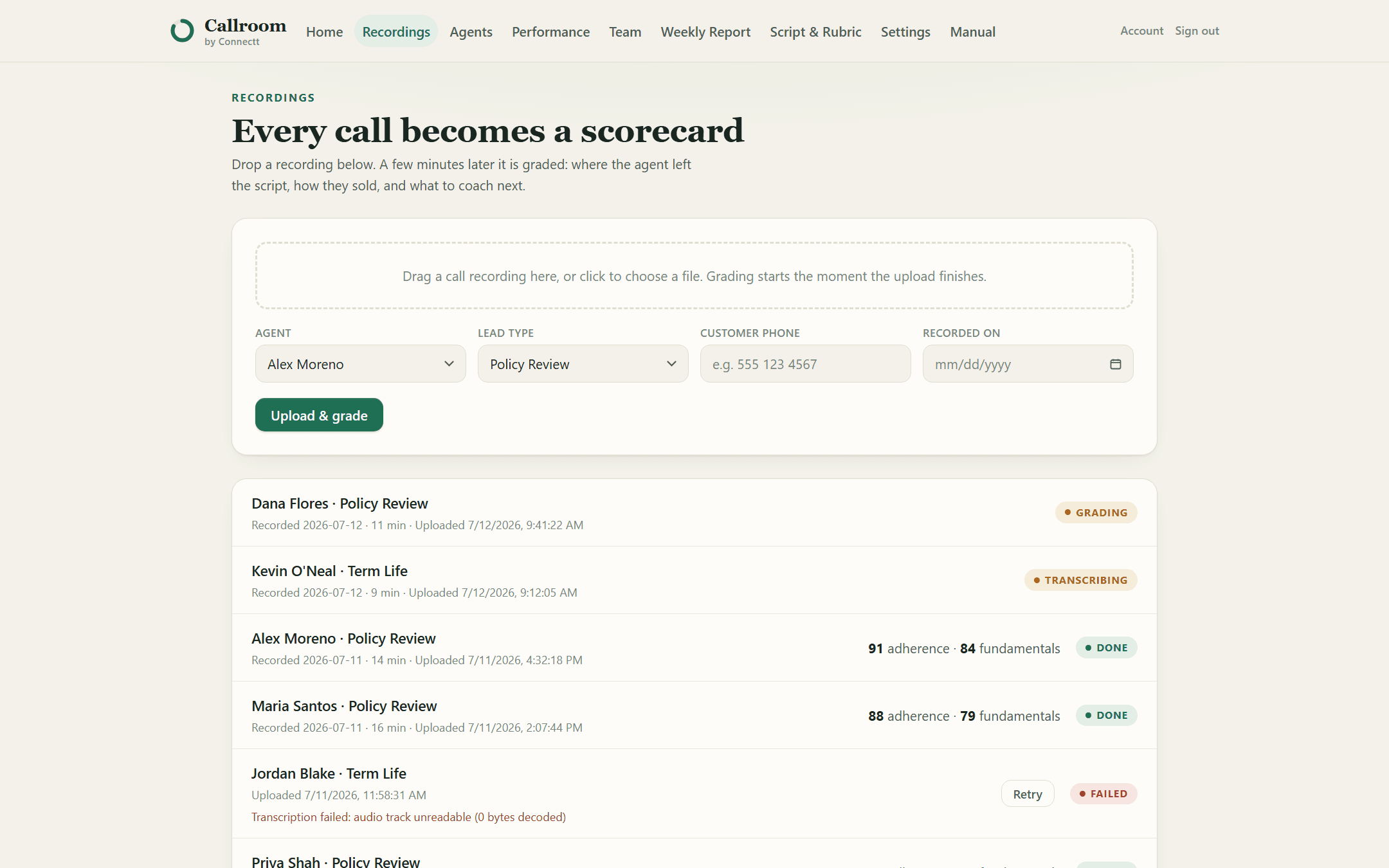
Insurance sales AI
Specific coaching evidence from recorded appointments.
Callroom takes a private recording through transcription, redaction, and a scorecard based on the team’s script and sales fundamentals. Managers keep the coaching judgment.
See the work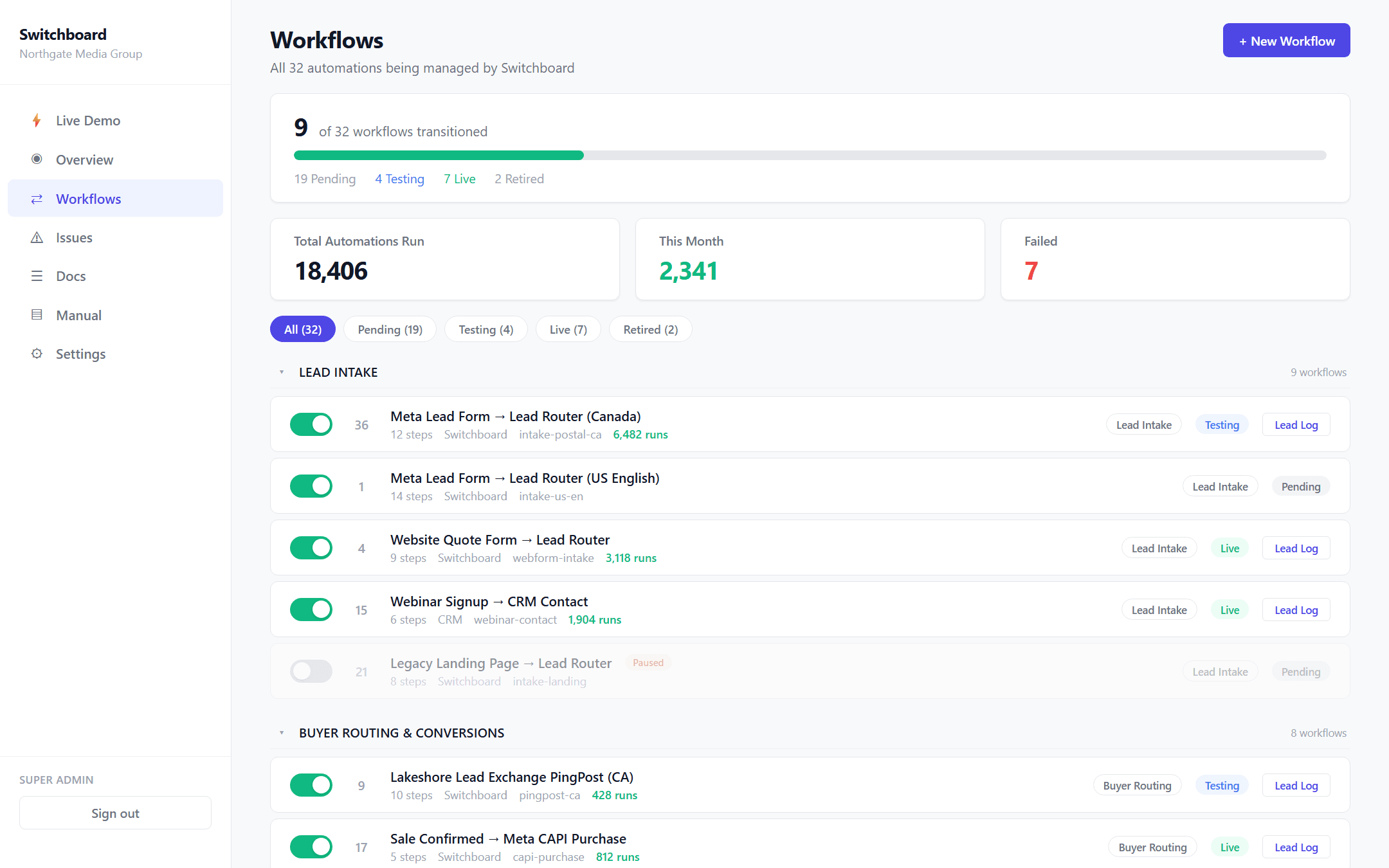
Automation infrastructure
An owned system replaced 32 Zapier workflows.
Searchable logs and replayable events made routing easier to trace. Recurring costs moved from about $1,750 a month in automation fees to under $50 for infrastructure.
See the workScreenshots use fictitious client data. Switchboard’s comparison covers recurring platform and infrastructure costs, excluding development and maintenance.
Where is manual work slowing your agency down?
I'd value your read on whether some of my ideas could help your agency. Open to taking a look?